
 Image 1 of 2
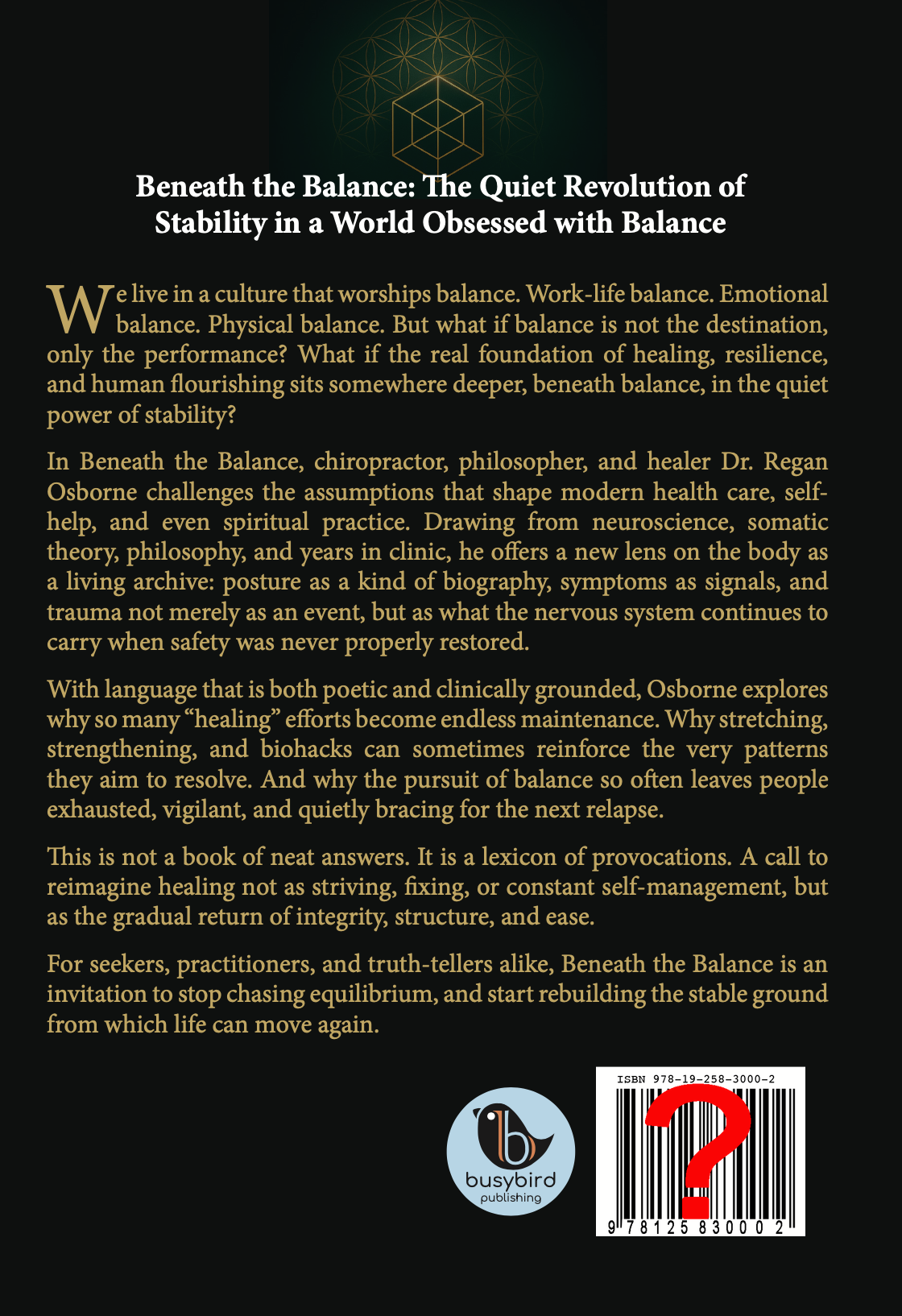 Image 2 of 2
We live in a culture that glorifies balance. Work-life balance. Hormonal balance. Emotional balance. Physical balance. But balance is not a foundation. It is a performance. It is often a compensatory skill the body learns when it no longer trusts its own centre.
In Beneath the Balance, chiropractor and clinician-philosopher Dr Regan Osborne invites readers into a quieter, deeper paradigm: stability. Not as rigidity, but as integrity. Not as control, but as an internal coherence that makes movement, adaptation, and healing possible without constant bracing.
Blending contemporary neuroscience, somatic theory, biomechanics, and lived clinical practice, Osborne explores why so many modern approaches to “healing” unintentionally train better compensation rather than true restoration. He re-frames trauma as what the nervous system carries forward, posture as a living language, and recovery as a process of returning to capacity rather than chasing symptom-free perfection.
This is not a manual of quick fixes, nor a spiritual bypass disguised as wellness. It is a grounded inquiry into the architecture of resilience: how humans adapt, how systems lose integrity, and how stability can be rebuilt through the body, the breath, attention, and time.
If you have ever felt that your “balance” is hard-won, exhausting, or fragile, this book offers a different possibility. Less striving. More structure. Less performance. More presence. A quiet revolution beneath the surface.
We live in a culture that glorifies balance. Work-life balance. Hormonal balance. Emotional balance. Physical balance. But balance is not a foundation. It is a performance. It is often a compensatory skill the body learns when it no longer trusts its own centre.
In Beneath the Balance, chiropractor and clinician-philosopher Dr Regan Osborne invites readers into a quieter, deeper paradigm: stability. Not as rigidity, but as integrity. Not as control, but as an internal coherence that makes movement, adaptation, and healing possible without constant bracing.
Blending contemporary neuroscience, somatic theory, biomechanics, and lived clinical practice, Osborne explores why so many modern approaches to “healing” unintentionally train better compensation rather than true restoration. He re-frames trauma as what the nervous system carries forward, posture as a living language, and recovery as a process of returning to capacity rather than chasing symptom-free perfection.
This is not a manual of quick fixes, nor a spiritual bypass disguised as wellness. It is a grounded inquiry into the architecture of resilience: how humans adapt, how systems lose integrity, and how stability can be rebuilt through the body, the breath, attention, and time.
If you have ever felt that your “balance” is hard-won, exhausting, or fragile, this book offers a different possibility. Less striving. More structure. Less performance. More presence. A quiet revolution beneath the surface.